High School
University
Chemistry
Biology
Physics
Math
The Science of Memory: How to Build Mnemonics That Actually Stick

A mnemonic is a tool that helps you remember difficult information. There are many types of categories of mnemonics that turn something arbitrary (a list, a sequence, a formula) into something your brain already handles well: a sentence, an image, a place, a rhythm. The best ones tend to be some combination of strange, personal, and tied to a concept you already understand. Then you test yourself on it over the next few days to see if it sticks for you.
I’ve been teaching and tutoring various subjects for over 15 years, and I can tell you that one of the most common study habits I see is also one of the least effective.
What is it you ask? You may be surprised to know that it is repetition. Students reread their notes as they rewatch the lecture recording. They read the chapter a third time the night before the test. It feels productive, because the page begins to look more and more familiar. Then they sit in front of a test booklet, and nothing comes out.
In a set of experiments run by Roediger & Karpicke in 2006, students who reread a passage four times remembered far less a week later compared students who read it once and then tested themselves on it three times. Additionally, the rereaders felt more confident about how well they knew the material. That kind of false overconfidence combined with shaky knowledge is a slippery slope.
Most of the time, it’s not that the student has a bad memory, it’s the methods they are employing that are the problem. And that is very fixable. Below is how memory works, six mnemonic types with science examples, and the rules I give my students.
How Memory Works in Plain Language
You don’t need a neuroscience course or degree to study well. You just need to understand these three main ideas.
Encoding is how information gets into the brain. Information encodes better when it connects to something you already know and it is processed in more than one way (reading it, saying it, drawing it).
Consolidation is the process of long-term memory formation through integration into existing memory networks. Sleep is also an essential part of consolidation, which is why I always recommend it over an all-nighter!
Retrieval is how information gets out of the brain. Every time you successfully recall something, the memory gets stronger and easier to find next time.
Mnemonics live at the encoding stage. They’re a way of making seemingly arbitrary information vivid and connected, so it encodes well in the first place. But this step only pays off if consolidation and retrieval are also worked on. A mnemonic you never test yourself on is just a fun sentence that gets moved into your brain’s recycling bin.
Why Rereading Feels Like Studying (but Mostly Isn't)
When you reread, your brain recognizes the material. Recognition is fast and easy, and it produces a comfortable, safe feeling of "I know this." But a test doesn’t ask you to recognize. It asks you to recall and prove your understanding.
Recognition and recall are different skills, and rereading only trains the first one. This is why students tell me they "knew it" and still lost marks. They did know it. But only in the recognition sense. They never practised retrieving it.
The fix is simple to say and much more uncomfortable to do. Close the book. Write down what you remember. Then open the book and check. The gap you find and fill in is where the actual studying begins.
Six Types of Mnemonics, with Science Examples
1. Acronyms
Take the first letter of each item and make a word.
Chemistry: OIL RIG. Oxidation Is Loss of electrons, Reduction Is Gain of electrons. Redox is a huge component of electrochemistry; every SCH4U and CHM135 student needs this, and it’s the one they remember years later. (It sure stuck with me!) I personally prefer OIL RIG over the also commonly taught “LEO (Loss of Electrons is Oxidation) goes GER (Gain of Electrons is Reduction)” as it is a real word.
Biology: MRS GREN for the characteristics of living things (movement, respiration, sensitivity, growth, reproduction, excretion, nutrition).
Math: BEDMAS for the order of operations. Brackets, Exponents, Division, Multiplication, Addition, Subtraction.
Acronyms work best for shorter lists.
2. Acrostics
Take the first letter of each item and make a sentence.
The seven diatomic elements (H₂, N₂, F₂, O₂, I₂, Cl₂, Br₂): Have No Fear Of Ice Cold Beer.
Taxonomy (kingdom, phylum, class, order, family, genus, species): King Philip Came Over For Good Soup.
These work because they’re silly little sentences that are more fun to remember. Acrostics are also a great tool for ordered sequences.
3. Association and Image Mnemonics
Link a new term to a picture, visual, or idea. The stranger it is, the better.
If you keep confusing endothermic and exothermic, picture heat entering a house through the door (endo, in) and heat exiting through the window (exo, out). Now you can even add something ridiculous: the heat is a goose flailing in and out of your second story room.
For the mitochondria as the main site of cellular respiration, students have been drawing a tiny power plant inside the cell for decades. There are memes going around stating that “mitochondria are the powerhouse of the cell” being the only things people remember from science class for a reason!
4. Method of Loci (The Memory Palace)
Put the things you need to remember in a familiar place, in order, and visualize walking through it in your mind.
For the ten steps of glycolysis, walk through your house. Glucose is at the front door. Hexokinase is in the hallway, phosphorylating it. The next enzyme is in the kitchen. And so on. It sounds elaborate. It takes a bit more time and effort to set up, but it holds an ordered sequence very well.
This is the technique competitive memory athletes use, and it works for BIO120 and BCH210 just as well as it works for decks of cards.
5. Rhymes and Rhythm
Your brain holds rhythm easily. That’s why you still know songs from when you were a child.
"-ite is lite": for polyatomic ions, the -ite form has one fewer oxygen than the -ate form (nitrite NO₂⁻, nitrate NO₃⁻; sulfite SO₃²⁻, sulfate SO₄²⁻).
If a rule is short and you need it fast, give it a beat!
6. Chunking
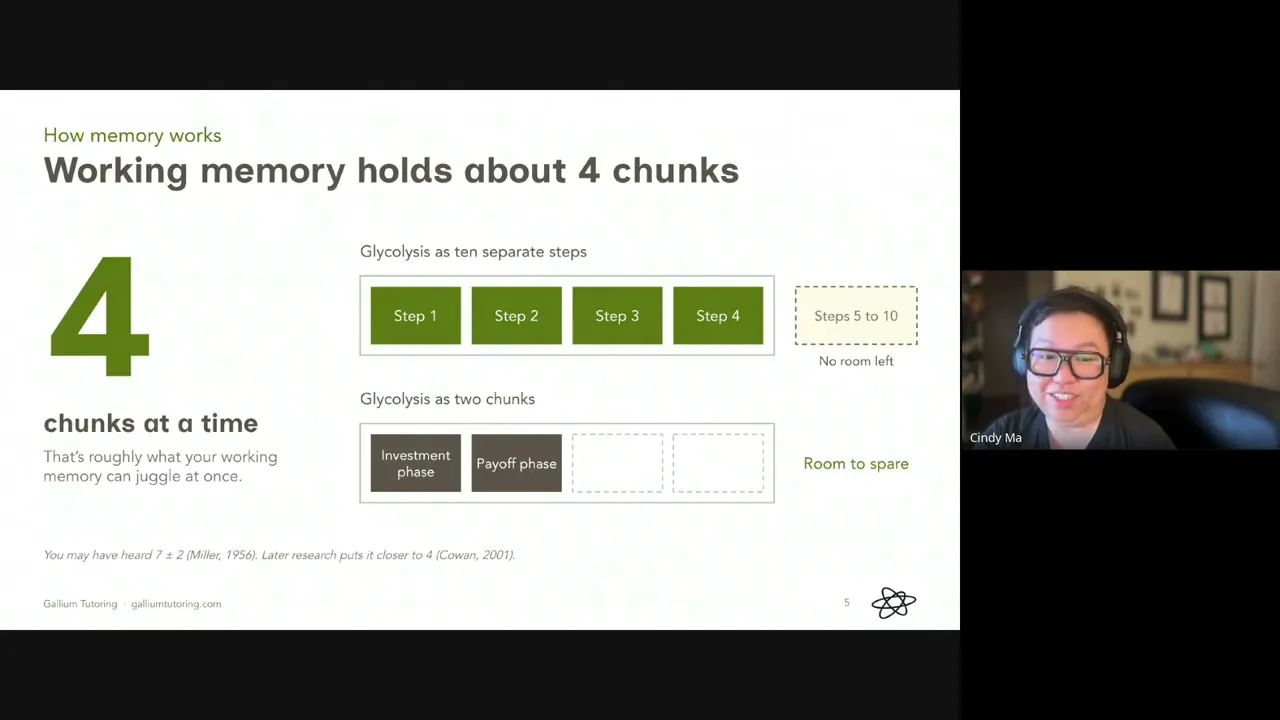
Break a long list into groups or categories. In 1956, Miller published his revolutionary discovery that short-term memory only holds about 7 (±2) items at once. This is why phone numbers are broken down into groups of 3, 3, and 4 - much easier to remember than 10 digits in a row!
Cell organelles with their alien sounding names can be much more manageable sorted by function. For example, nuclei and nucleoli can be put under cellular control and information, while ribosomes, endoplasmic reticulum, and golgi apparatus can be put under material transport and manufacturing.
Functional groups can be sorted by the types of atoms they contain. For example, you can put alkanes, alkenes, alkynes, and aromatics under a hydrocarbon umbrella.
The Rules That Make a Mnemonic Stick
I’ve watched hundreds of students build mnemonics. The ones that survive to exam day follow four rules:
Make it strange. Your memory holds on to what’s vivid, odd, and slightly embarrassing. A plain mnemonic is a mnemonic you’ll forget. The oil rig should be losing its electrons into the sea, scored with the dramatic sounds of Beethoven’s Fifth Symphony.
Make it yours. A mnemonic you built beats one you were given. Building it is in and of itself an act of encoding. Use your friends’ names, your street, or your inside jokes.
Tie it to meaning. A mnemonic is a tool, not a substitute for understanding. OIL RIG helps you remember which is which. It won’t help you predict what gets oxidized in a reaction. Understand the concept first, then build the tool. (This is most of what I do in tutoring sessions, and it’s why my students’ marks go up in the course, not just on the memorization questions.)
Test it out. Build it tonight. Tomorrow morning, before you look at anything, try to recall it. If it comes easily, you built it right. If it doesn’t, the image wasn’t strange enough or it wasn’t connected to something you knew. Rebuild and test again the next day.
What Not to Mnemonic
Don’t build a mnemonic for everything. If you need a mnemonic for every concept in a chapter, the problem is understanding, not memory, and a hundred acronyms will collapse under their own weight on exam day.
Mnemonics are for the genuinely arbitrary: sequences, lists, which-is-which pairs, constants. For everything else, the bulk of the work is understanding why, and then practising retrieval.
A Three-Step Routine Before Every Assessment
Close the book and write. Take a few minutes to brain dump everything you remember about the topic onto a blank page. (Okay, it doesn’t have to be completely blank - it can be lined or grid paper or some fancy stationary!)
Check and mark the gaps. Open your notes. Circle what you missed. Those circles are your study list; everything else is already done.
Build tools for the arbitrary gaps. Anything that’s a list, sequence or pair can get a mnemonic. Anything that’s a concept gets some practice problems or a review instead.
Space this cycle out over multiple sessions and days and repeat as needed.
Frequently Asked Questions
Do mnemonics actually work for science, or just for lists?
They work for the arbitrary parts of science (of which there are many): sequences, lists, which-is-which pairs, and constants. They don’t replace understanding a mechanism or being able to solve a problem.
How long does it take to build a good mnemonic?
Two to ten minutes, depending on the type. A memory palace for a ten-step pathway would land at the longer end. The time is worth it, especially if you’ll need the information for more than one test or course.
Is rereading ever useful?
Yes, the first couple of times to build understanding. After that, it should be replaced with self-testing. If you find yourself on a third reread, close the book.
My kid studies for hours and their grades don’t improve. Is this the problem?
Very often, yes. Hours of rereading and highlighting produce familiarity, not recall. Switching to closed-book self-testing is usually the single biggest change that moves the grade. If it doesn’t, the gap is usually a lack of understanding.
If You're Still Stuck
Everything above is what I taught in a free 45-minute online session on October 13, 2026. The replay is at the top of this page if you’d rather watch than read.
And if you’re in a science or math course right now and it already feels heavy, that’s the stuff I love to think about every day. Book your free 15-minute intro call, tell me what course you’re in and what’s not clicking, and we’ll figure out whether tutoring is the right next step. No pressure either way.
Cindy Ma (they/them) holds an MSc in Biological Chemistry from the University of Toronto and a BSc in Pharmaceutical Chemistry from the University of Toronto. They have tutored high school and university STEM courses for over ten years, and run Gallium Tutoring, an online tutoring practice based in Toronto. ORCID · LinkedIn